
Executive Summary
In February 2021, Defense for Children International–Palestine (DCIP) reported that Israeli interrogators had raped a 15-year-old Palestinian boy in detention. Rather than investigate the allegation, Israeli forces raided DCIP’s offices and later designated it—along with five other Palestinian human rights groups—as a “terrorist organization.” While such abuses and crackdowns are not new, this moment marked a decisive escalation: the shift from harassment of Palestinian civil society to its outright criminalization with the full support and participation of the US.
In 2025, the Trump administration designated six Palestinian organizations under counterterrorism frameworks before advancing even further, sanctioning leading human rights groups for engaging with the International Criminal Court. These measures move beyond targeting individual actors to undermining the very infrastructure of international accountability. This policy brief argues that the campaign by the US and the Israeli regime against Palestinian civil society and international law carries global consequences, threatening mechanisms designed to hold state violence in check. It offers the following recommendations for how Palestinian organizations and their allies can adapt, defend themselves, and pursue justice in an increasingly hostile environment.
Recommendations
Defensive strategies
- Coordinate legal challenges to sanctions and designations. Palestinian civil society organizations and their allies should pursue coordinated legal challenges to delay enforcement, expose executive overreach, and build a public record of repression. Litigation should be paired with public campaigns that frame these measures as attacks on civil society and democratic space.
- Diversify and de-risk funding sources. Given the US’s dominance of global financial systems, organizations must reduce reliance on US-based donors and intermediaries by developing alternative funding mechanisms and expanding solidarity-based models. Diversification is now a matter of survival.
- Strengthen collective coordination and risk-sharing. Organizations should deepen coordination on legal defense, security, communications, and rapid-response mechanisms. Shared resources, regular consultations, and visible international solidarity are essential to countering isolation and intimidation.
Offensive strategies
- Develop Global South–led accountability pathways. Palestinian civil society organizations and their allies should deepen engagement with Global South states and alternative forums willing to challenge impunity. These alliances must be sustained and defended against external pressure.
- Press Europe to close the gap between rhetoric and responsibility. European governments have acknowledged the illegality of US sanctions but have largely failed to act. Civil society organizations should increase pressure through litigation, parliamentary engagement, and public advocacy to make inaction politically costly.
- Reframe accountability as a political struggle. As international legal mechanisms are constrained, accountability must be pursued through broader political strategies that mobilize public opinion, engage policymakers, and strengthen transnational solidarity.
Introduction
In February 2021, Defense for Children International–Palestine (DCIP) reported that Israeli interrogators had raped a 15-year-old Palestinian boy while he was detained in Israel’s al-Mascubiyya prison in East Jerusalem. DCIP shared the allegation with US State Department officials, who reportedly raised it with Israeli authorities. However, rather than investigate the abuse, Israeli forces raided and ransacked DCIP’s Ramallah offices and later designated the organization, along with five other Palestinian human rights groups, as “terrorist organizations.”
Allegations of torture and sexual violence in Israeli detention facilities are not new, nor is Israel’s targeting of Palestinian human rights organizations. What the incident marked, however, was a coordinated escalation by Israel—one that moved beyond the usual harassment and obstruction of organizations documenting Israeli abuses toward their outright criminalization and neutralization. This assault on Palestinian civil society has only intensified with the full support and participation of the US.
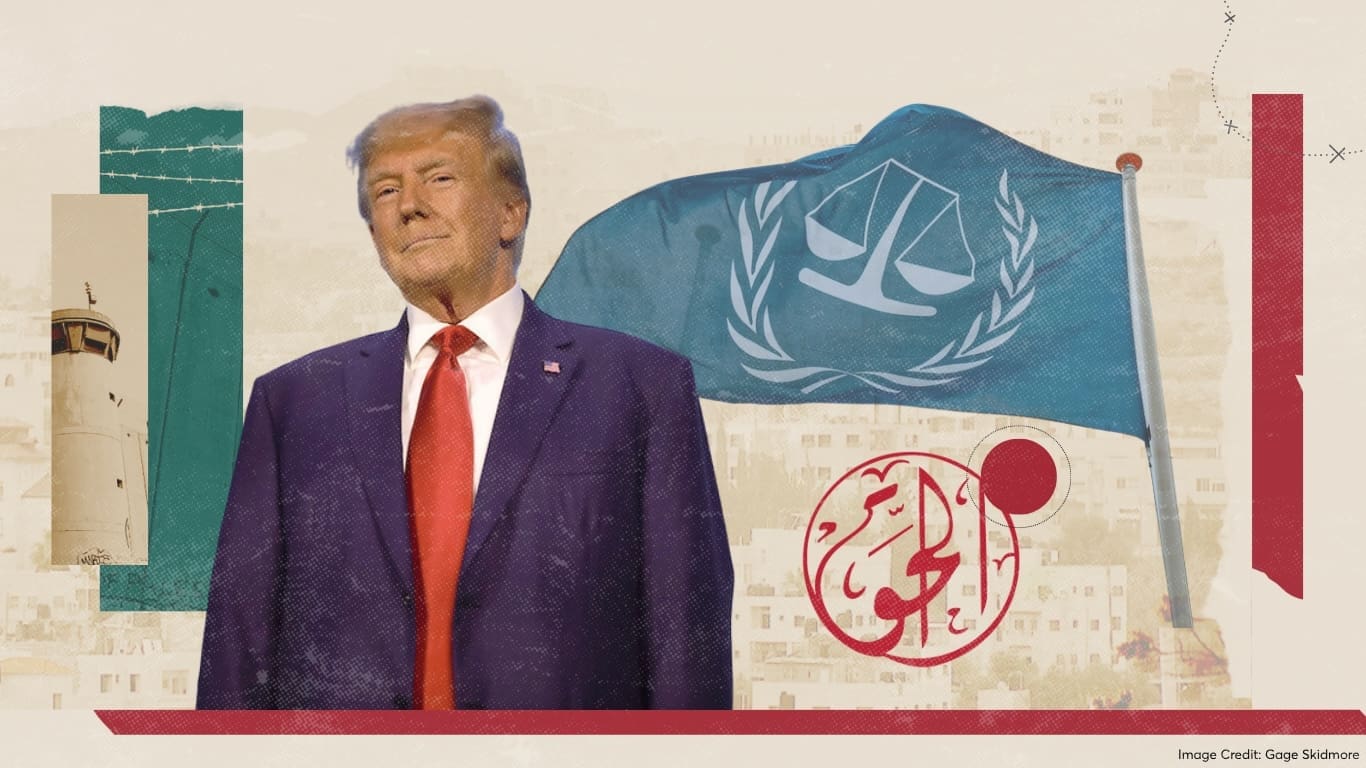
In June 2025, the Trump administration joined the fray by adding six Palestinian organizations to its Specially Designated Global Terrorist (SDGT) list, deploying a familiar counterterrorism framework. Among those designated was Addameer, one of the leading Palestinian prisoners’ rights organizations. Three months later, Washington turned to new tactics, sanctioning human rights organizations Al-Haq, the Palestinian Centre for Human Rights (PCHR), and Al-Mezan, not under the usual counterterrorism authorities, but under the recently signed Executive Order 14203—a measure designed to punish organizations and individuals for engaging with the International Criminal Court (ICC).
While the Trump administration’s terrorism designations sought to delegitimize human rights organizations by recasting them as security threats, the ICC-related sanctions go further, criminalizing engagement with international justice mechanisms themselves. Taken together, these measures signal a shift from attacking Palestinian advocacy in a targeted manner to dismantling the global infrastructure of international accountability itself.
This policy brief argues that the campaign by the US and Israel against both Palestinian civil society and international law carries consequences far beyond Palestine, threatening the international mechanisms of accountability that serve as a check on state violence worldwide. It also provides recommendations for how Palestinian organizations and their allies can adapt, defend themselves, and pursue justice in an increasingly hostile global environment.
Dismantling the Infrastructure of Accountability
Washington’s escalation against Palestinian civil society organizations is driven not only by a desire to shield Israel from accountability but by the recognition that holding Israeli officials accountable for war crimes and genocide could establish a precedent exposing American officials to similar legal scrutiny. The successful prosecution of Israeli officials—particularly for genocide and war crimes in Gaza—would inevitably raise questions about US complicity via arms transfers, intelligence sharing, and diplomatic cover. It would also risk normalizing legal pathways that could later be applied to US officials for unresolved crimes committed in Iraq, Afghanistan, and elsewhere. In other words, the intensifying assault on the ICC is as much about preserving US impunity as it is about shielding Israel from accountability.
The intensifying assault on the ICC is as much about preserving US impunity as it is about shielding Israel from accountability SHARE ON XAt the same time, we cannot explain Washington’s response solely in terms of fears of legal precedent. Israel occupies a central position in US regional strategy, serving as a key military partner, intelligence collaborator, and hub for US defense contractors. Protecting Israel from international accountability, therefore, also aligns with a broader strategic commitment to preserving Israel as a central node of US power projection. In this sense, we must recognize the assault on Palestinian civil society as inseparable from a broader project—the abandonment of even the pretense of universality that once underwrote the so-called rules-based international order in an effort to preserve the status quo of US dominance.
It was precisely their central role in advancing accountability under international law that made Al-Haq, the PCHR, and Al-Mezan strategic targets for the US sanctions regime. For years, these organizations—alongside Addameer—formed the backbone of the forensic, legal, and evidentiary infrastructure underpinning investigations into Israeli war crimes and genocide before both the ICC and the International Court of Justice (ICJ). Through systematic documentation, legal analysis, and field investigations, they helped build the evidentiary record on which these cases were being built.
That work was beginning to yield concrete results. In November 2024, the ICC issued arrest warrants for Israeli Prime Minister Benjamin Netanyahu and former Defense Minister Yoav Gallant on charges including the use of starvation as a method of warfare and other war crimes and crimes against humanity. As public sympathy for Palestinians grew and criticism of Israel intensified, the prospect of accountability ceased to be merely theoretical, and demands for enforcement became increasingly difficult to ignore. Yet, rather than reassessing its role in enabling Israeli impunity—as required under international and domestic US law—Washington escalated its efforts to suppress domestic dissent and obstruct international accountability mechanisms.
Executive Order 14203: Weaponizing the Financial System
Unlike earlier sanctions that relied on terrorism allegations, the Trump administration imposed measures against Al-Haq, PCHR, and Al-Mezan under Executive Order (EO) 14203, which explicitly targets engagement with the ICC itself. Signed in February 2025, the order weaponizes US dominance over the global financial system by authorizing the US Treasury to designate, sanction, and financially immobilize any individual or organization deemed by the State Department to be “assisting” the ICC in ways that could expose US or allied personnel to prosecution for war crimes and other crimes against humanity. EO 14203’s scope extends far beyond court officials to encompass legal experts, researchers, funders, and human rights organizations that document violations or provide expertise to the ICC.
Under this framework, the Trump administration designated Al-Haq, PCHR, and Al-Mezan as sanctionable entities precisely because of their role in supporting the ICC’s investigation into Israeli crimes in Gaza.
The implications are sweeping, as the order enables:
- A total ban on funding from US citizens, foundations, financial institutions, or organizations.
- A prohibition on providing goods, services, or any form of “material support,” including sharing information, legal analysis, or coordinating advocacy strategies.
- Severe restrictions on collaboration with US-based individuals, universities, NGOs, and research institutions.
- The blocking of assets and financial transactions, effectively severing targeted entities from the international banking system.
Washington’s dominance over the global financial system gives this censorship regime its devastating reach. Because most international transactions clear through US-linked banks and financial institutions, sanctions issued by the Treasury Department reverberate far beyond US borders. To avoid regulatory scrutiny, banks, donors, universities, technology platforms, and NGOs routinely overcomply with US sanctions, severing ties not only with designated organizations but also with individuals and institutions even tangentially associated with them. The result is a chilling effect that extends well beyond the letter of the law, constricting spaces for research, documentation, advocacy, and legal collaboration worldwide.
The impact of US sanctions against Al-Haq, PCHR, and Al-Mezan—as with Addameer’s designation three months earlier—was immediate and severe. US citizens on staff were forced to resign, while other employees continued their work without pay after banks shuttered the targeted organizations’ accounts. US-based funders and donors suspended contributions to avoid potential designation themselves.
The effects also extended beyond finances. YouTube removed hundreds of videos posted by the sanctioned organizations that documented Israeli war crimes and human rights violations, effectively erasing critical evidence from the public domain. At the same time, US-based civil society organizations that have long collaborated with the sanctioned groups were forced to end collaboration, wary that even communication could attract scrutiny from an administration that has signaled its campaign against Palestinian civil society is only beginning.
The Palestine Exception
The intensifying campaign to incapacitate Palestinian civil society—whether through terrorist designations or US Treasury sanctions—did not emerge in a vacuum. From the 2009 UN Fact-Finding Mission on the Gaza Conflict to Palestine’s accession to the Rome Statute and the opening of genocide and war crimes investigations before the ICC and ICJ, Palestinian and international human rights organizations have long relied on the same tools that enabled accountability under international law that other movements across the globe have leveraged: systematic evidence gathering, legal analysis, and appeals to universal norms. This strategy was not rooted in naïveté about the political limits of international law, but in the recognition that sustained documentation and legal advocacy had, at times, compelled scrutiny and had led to justice elsewhere.
The Trump administration designated Al-Haq, PCHR, and Al-Mezan as sanctionable entities precisely because of their role in supporting the ICC’s investigation into Israeli crimes in Gaza SHARE ON XIn Bosnia, for example, organizations such as the International Commission on Missing Persons provided critical evidence to proceedings before the ICJ by using advanced DNA analysis to identify victims recovered from mass graves linked to the 1995 Srebrenica massacre. This forensic work helped underpin the ICJ’s 2007 determination that the massacre constituted genocide and contributed to the subsequent conviction of dozens of Serbian officials for war crimes. But this outcome did not reflect the impartiality of international law. Rather, it demonstrated its feasibility only when those responsible for mass violence were politically expendable to the actors that retain disproportionate influence over international legal enforcement—most notably the US and its Western allies.
Every attempt to invoke international law in pursuit of justice for Palestinians has been met with repression aimed at denying Palestinians access to the same legal mechanisms that have succeeded in achieving justice elsewhere, reaffirming what amounts to a “Palestine exception” to international law. For example, the Palestinian Authority (PA) has repeatedly faced political and economic retaliation for seeking greater international recognition and pursuing membership in multilateral institutions—including its accession to the Rome Statute of the ICC—in an effort to leverage international legal frameworks to hold Israel accountable. Simultaneously, Israeli authorities have spent decades using military ordersand opaque intelligence claims to restrict funding, raid offices, and arrest staff of human rights organizations investigating Israeli war crimes and human rights violations.
What makes this moment distinct is that Israel and its allies in Washington are no longer limiting their repressive tactics to Palestinian organizations seeking to exercise their rights under international law. Instead, they are increasingly targeting the infrastructure that sustains international legal accountability. The aim is not merely to silence Palestinian civil society, but to ensure a future in which international law no longer poses even a potential constraint on the powerful. In other words, as Washington has concluded that the rules-based order it once championed no longer reliably serves its interests, it has shifted from selectively manipulating that system to actively undermining it.
An Inevitable Conclusion: US Opposition to Universality
Since the end of World War II, the US has sought to shape the international order in accordance with its interests as the dominant global hegemon. That imperative has defined Washington’s posture toward the ICC since its establishment in 2002. Across administrations, US officials have struggled to reconcile their claims to leadership of the “rules-based international order” with their long-standing refusal to subject the US—or its closest allies—to the same legal constraints imposed on others. From the outset, US engagement with the ICC has been driven by a determination to preserve control over when, where, and against whom international law may be applied.
Because most international transactions clear through US-linked banks and financial institutions, sanctions issued by the Treasury Department reverberate far beyond US borders SHARE ON XSuccessive US administrations have oscillated between tactical engagement and outright hostility to the ICC. President Bill Clinton signed the 1998 Rome Statute in 2000 but declined to submit it for ratification, signaling provisional acceptance of the Court’s legitimacy while withholding any binding legal commitment. Subsequent Democratic administrations supported the ICC when its actions aligned with US geopolitical interests, such as in investigations targeting adversaries, like the late Libyan leader Muammar Gaddafi or Russian President Vladimir Putin. More broadly, they tended to praise the Court as a vehicle for enforcing international norms abroad while dismissing it as overreaching or illegitimate when its jurisdiction extended closer to home.
Republican administrations, by contrast, have adopted a more openly confrontational approach toward the ICC. In 2002, President George W. Bush signed the American Service-Members’ Protection Act—widely known as the “Hague Invasion Act”—which authorized “extraordinary measures,” including the use of military force, to prevent any US national or citizen of a US-allied state from being surrendered to or detained by the Court.
At the same time, administrations of both parties have pursued bilateral immunity agreements designed to pressure ICC member states to exempt US personnel from the Court’s jurisdiction and to withhold cooperation from investigations Washington did not endorse. Taken together, these measures went beyond signaling US nonparticipation on jurisdictional grounds. They reflected a willingness to actively undermine the Court’s capacity to function as a universal institution whenever its mandate threatened US interests, citizens, or allies.
Even so, until recently, these measures largely stopped short of directly attacking the ICC, its personnel, or the organizations and individuals supporting its investigations. Washington routinely refused to comply with rulings that threatened its interests and shielded allies through diplomatic and political means, but had generally refrained from criminalizing engagement with the Court itself until Trump tested that boundary during his first term in office. Executive Order 13928, issued in 2020, authorized sanctions against a narrow set of ICC officials involved in investigations of US and allied conduct. However, the move was ultimately rescinded by the Biden administration, reinforcing the prevailing assumption that direct assaults on international judicial institutions were a step too far—and that US interests could still be secured through selective engagement rather than the outright repression of the international legal regime.
Viewed in this context, the recent sanctions imposed on Palestinian civil society organizations through EO 14203 mark a decisive break from Washington’s traditional posture toward international justice. Although these measures build on the same logic of exceptionalism that has long governed US policy toward the ICC and international law more broadly, they represent a significant intensification in scope. Rather than merely refusing to participate in international accountability mechanisms, Washington has moved to actively dismantle them, deploying its global financial and administrative power to punish not only ICC officials but also the civil society actors and legal experts that engage with the Court. This shift signals a deeper recalibration of US strategy. The Trump administration no longer treats international law as a tool to be selectively manipulated in pursuit of its foreign policy objectives, abandoning even the pretense of universality in favor of direct repression.
Global Repression and the Solidarity Movement
The consequences of the Trump administration’s assault on Palestinian civil society extend far beyond both the individual organizations directly targeted and the wider pro-Palestine movement. Where the US once managed the contradictions of the “rules-based” order—invoking international law when expedient and ignoring it when inconvenient—it is now moving to dismantle the mechanisms that made even selective accountability possible. The result is an emerging global order in which accountability without US approval is no longer feasible and attempts to pursue justice independently are treated as hostile acts.
For decades, other states have cited US hypocrisy to justify their own violations of international law; today, they are being offered a far more dangerous precedent: that international courts, investigators, and civil society actors may be sanctioned, dismantled, or criminalized outright whenever they threaten entrenched state power. The central question is no longer whether international law can deliver justice on its own, but how civil society can operate within a system deliberately stripped of its pretense of universality and its remaining claims to legitimacy, and replaced by an order that functions primarily through coercion and power projection.
This is the terrain on which Palestinian civil society now operates—and the terrain that future movements for justice and accountability are likely to inherit. Understanding this shift is essential not only to defending Palestinian organizations under attack, but also to reimagining how justice can be pursued in a world where the most powerful state has come to treat accountability itself as a threat.
Recommendations
A strategic recalibration is essential to advance accountability—one that prioritizes defense, resilience, and alternative pathways for pursuing justice under conditions of open hostility. The following recommendations are grounded in the recognition that the campaign against Palestinian civil society is structural rather than episodic, and that accountability strategies must adapt accordingly.
Defensive strategies
- Coordinate legal challenges to sanctions and designations. Palestinian civil society organizations and their allies should pursue coordinated legal challenges to sanctions, terrorism designations, and related repressive measures to delay enforcement, expose executive overreach, and build a public record of repression. Litigation should be paired with public campaigns that frame these cases as resistance to attacks on civil society and democratic space, rather than as a narrow technical legal challenge.
- Diversify and de-risk funding sources. Given the US’s dominance of global financial systems, Palestinian civil society and its supporters must reduce their reliance on US-based donors and financial intermediaries. This includes developing pooled funding mechanisms, working through non-US intermediaries, exploring alternative registration models, and expanding solidarity-based funding structures that distribute risk. While no funding pathway is entirely immune to US influence or infrastructural control, diversification is now a matter of survival.
- Strengthen collective coordination and risk-sharing. Repression thrives on fragmentation and isolation. Organizations should deepen coordination on legal defense, security protocols, communications strategies, and rapid-response mechanisms in response to new sanctions or designations. Joint statements, shared legal resources, regular strategy consultations, and visible international solidarity—even when costly—are essential to countering intimidation and isolation.
Offensive strategies
- Develop Global South–led accountability pathways. As Western institutions retreat from even symbolic commitments to universality, Palestinian civil society and its allies should deepen engagement with Global South states, regional bodies, and alternative forums and political blocs willing to challenge impunity, such as the Hague Group. Such alliances must be cultivated, sustained, and defended against external pressure.
- Press Europe to close the gap between rhetoric and responsibility. European governments have repeatedly acknowledged that US sanctions targeting international courts and civil society are unlawful, yet have largely failed to act. Existing legal tools, such as the EU Blocking Statute (Council Regulation (EC) No. 2271/96), exist precisely to counter extraterritorial sanctions like those imposed by the Trump administration, but remain largely unenforced. Palestinian and international civil society should increase pressure through litigation, parliamentary engagement, and public exposure, making continued European inaction politically costly rather than treating rhetorical opposition as meaningful resistance.
- Reframe accountability as a political struggle. International courts are not substitutes for political organizing, particularly as the international legal system faces active dismantlement. Legal strategies—including documentation, litigation in national courts, and reporting—must be embedded in broader political strategies that mobilize public opinion, pressure policymakers, and foster transnational solidarity. Accountability should be understood not as a purely legal exercise, but as an ongoing political struggle over power, legitimacy, and the future of international order.
Tariq Kenney-Shawa is Al-Shabaka’s US Policy Fellow and co-host of Al-Shabaka’s Policy Lab series. He holds a Masters degree in International Affairs from Columbia University. Tariq’s research and writing have covered a range of topics, from the role of open-source intelligence in exposing Israel’s war crimes to analysis of Palestinian liberation tactics. His writing has appeared in The Los Angeles Times, Foreign Policy, and The Nation, among others. Follow Tariq on Twitter @tksshawa and visit his website at https://www.tkshawa.com/ for more of his writing and photography.